Please visit Marketing Land for the full article.


If you’re a SaaS business, chances are support is one area of your business that you want to be flawless. Providing great support is the key to your growth and success. According to an Oracle study, 9 out of 10 customers have abandoned a business because of a poor customer support experience. You don’t want to be that business, do you?
At the same time, customer support can be the most time-consuming (and expensive) activity in your business if it’s not handled correctly. Hence, the way you provide support can make or break your business. It’s not one of those things you can do “quick and dirty” at first and then improve later. Well, you could, but that would be a very risky decision.
I’ve been running SaaS companies for the last 15 years. In the early days, support meant email, and that was not very efficient. Then came the help desks, the chat solutions, the knowledge bases, and a lot of tools that made support optimization possible.
In 2015, it’s much easier to build a top-notch support system, but despite all the available solutions and content on the topic, I still stumble upon SaaS products that are not doing it right. I’d like to share my experience with you so you can optimize your support process, too!
When an app user needs support, she’s already entered into “frustration mode.” In most cases, she’s trying to figure out something or trying to do something with your app and cannot do it intuitively. Maybe your product is too complex to be 100% intuitive, or maybe certain features are not user friendly enough. She may have encountered a bug or is missing a feature that is key for her. Whatever the reason, as soon as she needs an answer, she tries to locate the “support” link. And if she can’t find it within 5 or 10 seconds, her frustration grows.
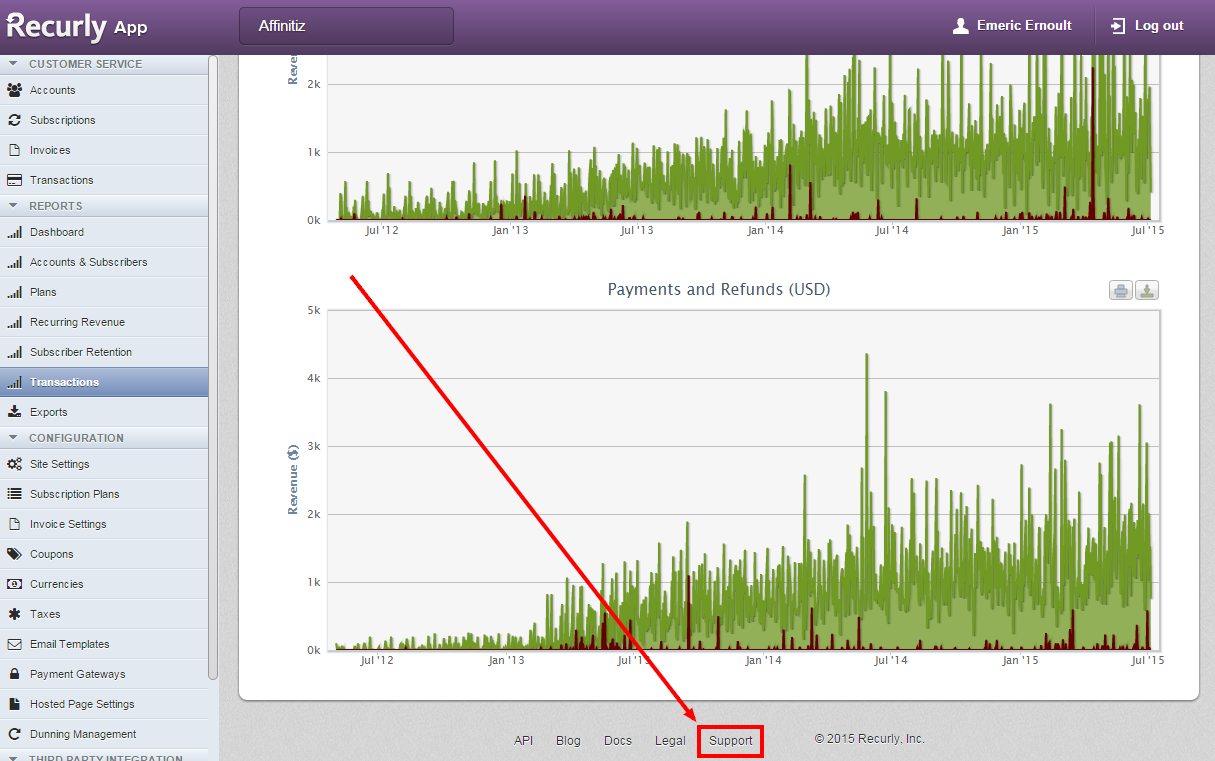
I’ve lost count of the number of SaaS apps I’ve used that have hidden access to their support resources so well that it took me a full website audit to find it! We use Recurly to handle our subscription payments; look how well they’ve hidden their support link in the footer, in small print:
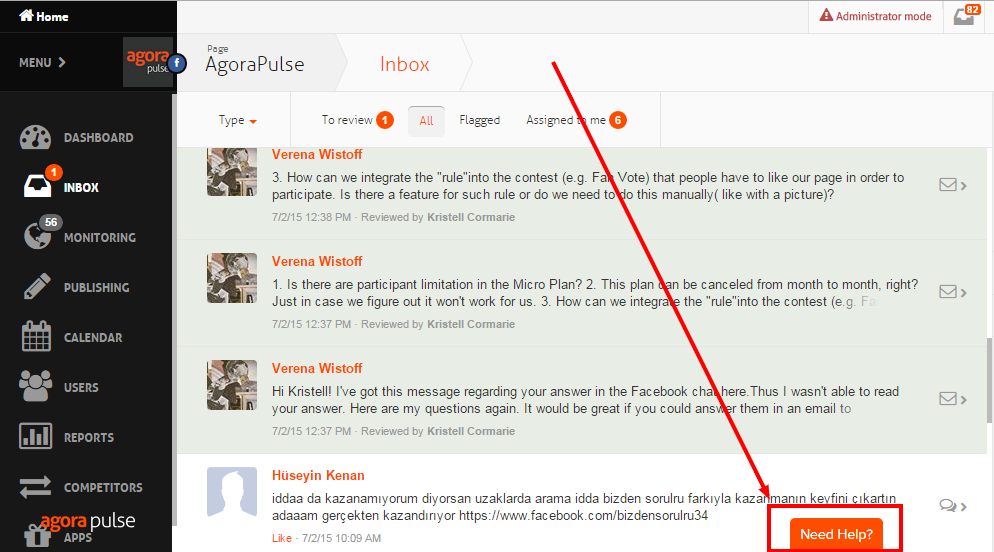
If you use our app, on the other hand, the support tab is much more obvious. It’s right there under your eyes at all times:
Hiding your support resources or, worse, contact channels is NOT the kind of mistake you want to make. And there are no excuses, as the solutions to fix the problem exist and are not difficult to implement.
Ideally, your support contact form and your support resources should all be accessible via one very visible support tab or link.
Products like Zendesk, UserVoice, or Support Hero will do that for you. That’s an easy win that won’t take more than five minutes in most cases.
I don’t know about you, but most of the time, when I have a question about a SaaS product I’m using, I’d much rather find the answer on my own, in five minutes, than have to send a support ticket and wait on an answer for two hours or, worse, two days!
I’m not the only one. A recent study recently conducted by Zendesk showed that 67% of users prefer self-service support over speaking to a company representative. And a whopping 91% said they would use a knowledge base if it met their needs. No wonder all the major help desks offer a knowledge base along with their ticket management system.
But here’s the problem: if you ask any support person if they know how well their knowledge base is working, the answer you’ll get every time will be, “I have no idea.” I used to have the same answer with our own knowledge base. We had one – it took us days to build – but still, we had no idea if our investment was paying off.
We tried to leverage the statistics provided by the tools we were using, but, at best, the only stats we got were the number of times FAQ articles were read and the keywords users entered when they searched for answers. That didn’t really help.
These are the insights we were looking for:
The software we finally decided to use was Support Hero. It had the advantage of giving us the information we needed in order to understand how well our self-help knowledge base was working and how we could improve it!
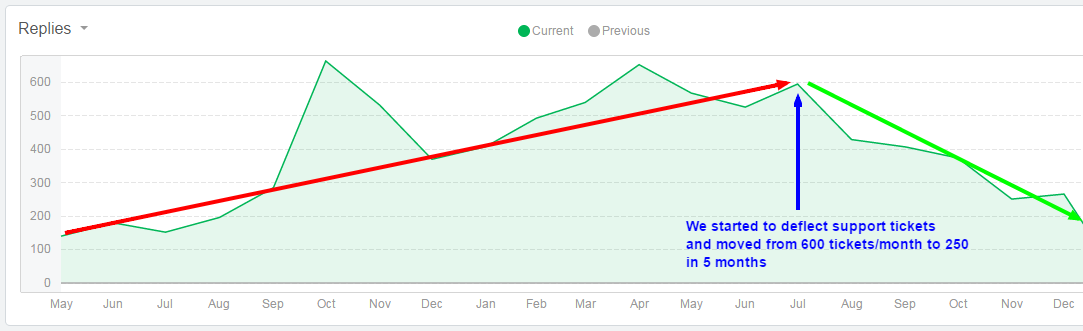
Thanks to these insights, we reduced our incoming support tickets by an astounding 50%. As you can see on the graph from our Helpdesk’s statistics, below, our inbound support ticket volume was becoming unbearable despite the existence of a knowledge base (hosted on UserVoice at the time). We gathered insights about the performance of our knowledge base, and, after two months of fine-tuning, we got back to a level we could manage.
Basically, if you want to better deflect support tickets with your self-help knowledge base, you have to understand how well it’s working and use that knowledge to improve it.
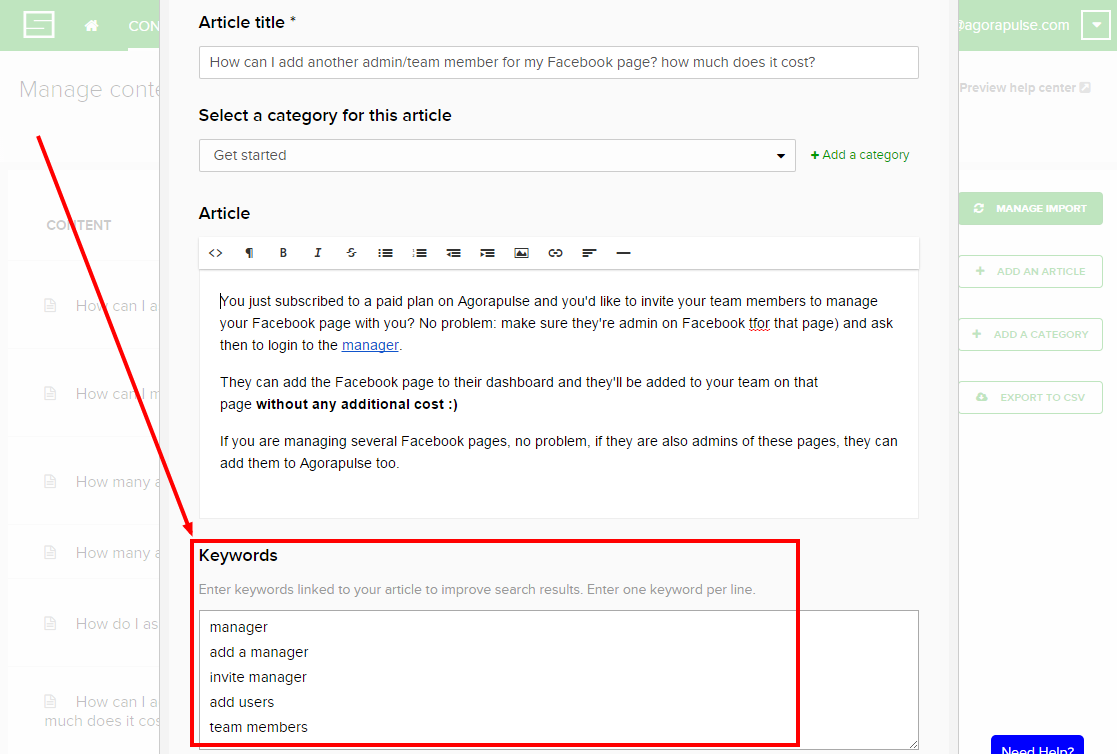
For example, we had a FAQ article explaining how to add other admins to an account on Agorapulse. That article referred to the word “admin.” But looking at the data we gathered through Support Hero, we quickly realized that our users were typing in a whole range of different words to search for this. For example, they used “team members,” “users,” or “managers.” For those three keywords, no article was showing up, leading to a support ticket every time. All we had to do was add those keywords to the FAQ as shown below and, presto, no more tickets on that feature!
Support requests usually fall into three major categories:
Bugs are the first problems you need to get rid of. But, honestly, having been in SaaS for years, I can tell you that you’ll always have bugs, especially if you’re building new features on a regular basis or making changes to your existing code. An optimized support process will not prevent bugs from happening, and the corresponding support tickets will come in. There isn’t much you can do here.
All SaaS products are, by definition, not finished. There’s no such thing as being done when you build a software application; there will always be features missing from your product. But if a missing feature keeps showing up in the support requests you get, adding that feature is probably not a bad idea. Not only will you receive fewer requests from your customers about it; but, more important, you’ll make them happier, and they’ll stick around longer.
If you decide that a feature should not be built (let’s say it doesn’t fit in your midterm roadmap), at least create a FAQ entry explaining why and offering alternative solutions. The last thing you want is a frustrated customer left wondering why you wouldn’t accommodate her.
But if you really want to get fewer support tickets, the category you need to pay the most attention to is the one of confusing or hidden features. A confusing feature is a feature your users were able to spot but couldn’t figure out. A hidden feature is a feature you actually have but users couldn’t find.
Both are problems, and they can be big problems. A good support system should help you quantify how bad the problems are.
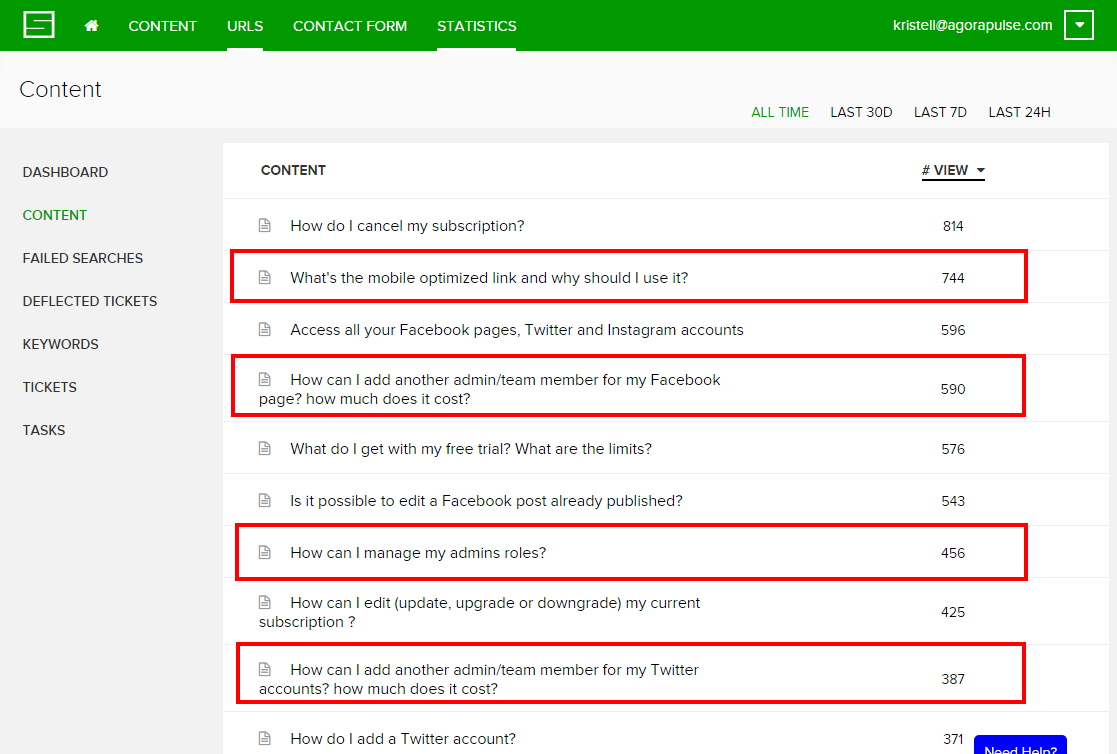
Let me give you an example we experienced firsthand. We recently had an internal debate about how our team feature was working. We were not agreeing on whether we were doing a good job of letting users manage their social media accounts as teams. So I called our support data to the rescue! I looked at our most-read FAQs, and guess what? The articles on team features were among the ones most read by our users:
Let me put it this way: if one of your features requires your users to read your knowledge base every time they want to use it, it’s definitely not doing a good job. A great product should be intuitive. I don’t know of any perfect product, of course, but if you look at your support data and identify a feature that requires your users to check your knowledge base all the time or search for answers, then working on making that feature more intuitive will definitely help. You will get more users as well as fewer support requests. Win-win.
Some support tools will help you spot the most-read articles or the most common search queries. To name a few: Help Scout, Groove, and Support Hero.
These days, communication goes in all directions – email, chat, in-app messages, Twitter, Facebook, and so on.
Your users don’t care what channel you prefer for support; they’ll use whatever is easiest for them at the time. Since most questions will arise as people use your product, you need to make sure that the way to contact your support team is very easy to spot (see above).
But you’ll always get emails from your website, Facebook messages, tweets, and even chat messages if you’ve decided to respond to your users in real-time. It can be totally overwhelming. Things start slipping through the cracks, conversation history is lost, and the list goes on. This is not sustainable. What you really have to do is concentrate most, if not all, of your support conversations in one place.
To communicate with our users, we’re using five different channels:
I have to say it’s challenging. And while we haven’t found any solution that would centralize everything, at least most of it goes to one place.
Our tool of choice to group all support requests is Help Scout. Thanks to its third party integrations, we are able to get all the Olark chats forwarded to Help Scout, so if we need to follow up on a chat conversation later by email, Help Scout does the job.
We receive very few support requests on Twitter, a few more on Facebook. But compared with the 20 or 25 requests we get daily by chat or email, the 4 or 5 requests we get every week on our social channels do not create a real problem. And we use our own tool to handle those social messages – “eat your own dog food,” as they say!
The main problem comes from the conversations we have via Intercom. Intercom is our tool of choice for in-app user communication. But Intercom is far from being as versatile and comprehensive a support tool as Help Scout. Ideally, we should switch everything to Intercom, but given the disruption this would create for our support process as of today and the fact that we’ve based that process on existing Help Scout features, it’s a hard move to make.
Now that Intercom provides real-time chat (it didn’t when we decided to start with Olark) and better support features (it was beyond poor two years ago when we started using it for in-app messages on top of Help Scout for support), if I were starting from scratch today, I would go all-in with Intercom and wouldn’t use Olark or Help Scout.
Help Scout and Olark both offer features that we like very much and would miss, but having discussions with users across several channels is a bigger problem. And we could replace Help Scout and Olark with Intercom, but not the other way around.
However, Intercom is missing a key feature when it comes to providing top-notch support: a knowledge base! Without a knowledge base, my support team would end up in the nuthouse! Fortunately, the solution we use for that, Support Hero, has an API connection with Intercom, and using both together does a perfect job.
Most SaaS CEOs think about product/technical support when they think about their support framework. They see support as a way to help current users understand how their product works and to help them solve bugs and technical issues.
It’s true that support in SaaS has always been primarily focused on helping current users of our products. But, limiting your support efforts to your current users is a big mistake.
There is actually a much larger population that expects support from you, and it’s a critical population for your business – your prospects. Actually, you probably have more prospects (i.e., website visitors) than current users, and ignoring them can be a very bad idea.
Your prospects will visit your website and check a couple of pages to get a general idea of your product. Maybe they’ll watch your video. If you’ve done a good job with your website, they’ll probably start becoming interested. But that’s also when they’ll start having questions pop up in their minds: Does your product connect with Salesforce? Is it available in Italian? Can we export our data in .csv? Is there a discount for nonprofits?
Most of the time, the answers to these questions will not be on your website. The goal of a website is not to address every potential question a prospective user has about how your product functions; its only goal is to sell the unique value proposition to convince them it’s worth their time digging around.
If you’ve succeeded in capturing the interest of prospects with your big value proposition, kudos to you. But don’t stop there; make sure they can also easily find all the cool features you have to offer.
To give you an example of that, I was recently looking for a new application to run NPS with our users. After a bunch of research on Google, I identified two potential solutions: SatisMeter and Promoter.io. They both had well-designed websites that conveyed their value proposition clearly.
But I needed answers to two important questions before making a decision:
Guess what? After scouting the two websites, I couldn’t find my answers. If the one(s) that were offering these features had allowed me to figure this out very quickly via a knowledge base, things would have been much easier and faster. Even more important, I would probably have ignored the competing solutions that were not responding to my questions!
Most important of all, I decided to eat my own dog food a couple of weeks ago and installed the Support Hero knowledge base widget on our website. So I verified all of the above: prospects are not looking for the same answers as current users; their questions will relate to your pricing, the languages you offer in your app, and all the nitty gritty options that you may or may not have (and, of course, which they badly need).
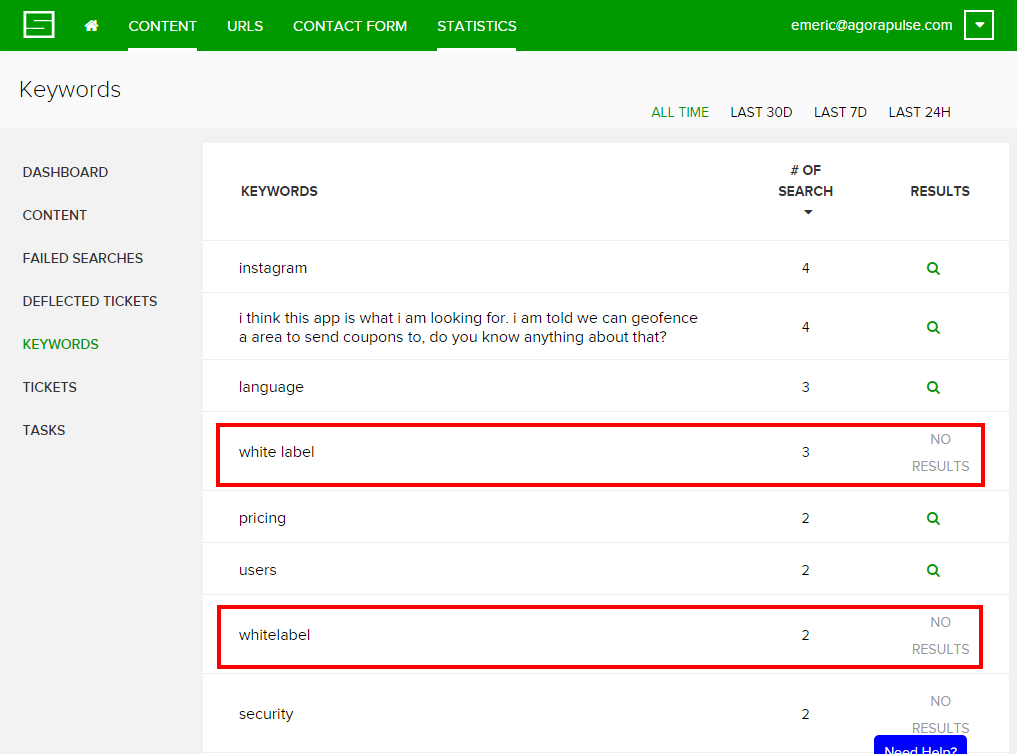
Now look at the screenshot below. Five users wondered if we had a white-label option. We actually do, but as you can see, no content was showing for those requests. I probably lost five customers because I didn’t do my job properly.
First, you need to accept that support is not a “set it and forget it” kind of thing. Like everything else in SaaS, you’ll need to constantly iterate, analyze and improve. You’re being lean about your marketing? Your product development? Your pricing? Support is no different.
Second, make sure it’s easy to find support. This really is the most common mistake and it’s easy to fix.
Then, invest in self help support and keep in mind that more than two users out of three will rather find her answer on her own rather than contacting support. There’s a common misconception among startup founders that they need to talk to customers and support is a good way to do that. It’s actually not. When users get frustrated enough to contact your support, knowing that they’ll have to wait more than they’d like to get the help they’re looking for, they won’t be in the right mood to chat with you. Yes, it is a good thing to talk to customers. But it’s not a good thing to force them to do so by not providing them with self help answers.
Finally, understand that support is not a stand-alone activity, it is deeply entangled with everything else you’re doing: product design, missing or messed-up features, marketing and customer success. Make sure you include what you learn from support in everything else you do for your SaaS business.
Your turn. What’s your experience with support? What have you learned that I’ve missed in this post? I’d love to benefit from your experience too!
About the Author: Emeric is the CEO and co-founder of agorapulse, a Paris and San Francisco based Social Media Management Software launched in 2011. Agorapulse is currently being used by more than 5,000 businesses across 180 countries. He is a regular speaker at Facebook Marketing conferences such as the AllFacebook Marketing Conference, Facebook Success Summit, iStrategy and the Online Marketing Institute.


Geo-Targeting Can Skyrocket Your Conversion Rates! written by Guest Post read more at Small Business Marketing Blog from Duct Tape Marketing

photo credit: In the Palm of My Hand via photopin (license)
As the internet continues to grow at an exponential rate, the average web user is overloaded with a vast amount of information. Website owners only have a few seconds to convince someone that the content on their website is worthwhile reading before the visitor moves on. While there are many methods of engaging your visitors and increasing conversion rates, one that is hardly spoken of but is used by all the big players is ‘Geo-Targeting’.
Geo-Targeting in simple terms refers to targeting a visitor based on their geolocation (country, state or city). It involves dynamically delivering web content so that it is highly related to your visitor’s location. Relevant information is the key in catching a visitor’s attention and improving engagement. People are naturally drawn to events and deals that are happening around them. By Geo Targeting your website’s information, your visitors will feel more comfortable and familiar with the content displayed. This will not only enhance their browsing experience, but it will increase trust, separating you from your competitors.
A simple example of geo-targeting web content is dynamically altering phone numbers based on a visitor’s location. Having a phone number right on top of the website is a great way to improve call through rates for your business. However, as this space is prime real estate, it only makes sense to display the relevant phone number to the visitor. Geo-targeting can avoid having to display a long list of phone numbers in your website’s footer or on a separate page altogether.
Displaying popups on your website based on a visitor’s location is a great way to target promotions. Let us take a restaurant business, for example, that has several branches spread around the country. Each branch could be running a different deal. The branch in Los Angeles is offering 10% off all burgers. The branch in San Francisco could be offering half price Tuesdays and so on. Using a single website, the restaurant can display the relevant deal to each of its local audiences in the form a popup.
Global companies often have multiple versions of their website tailored to suit each country with a country level domain (.au, .co.uk, .fr, .my, etc.). Having a local domain can greatly increase trust and relevance. It also makes it easy for the company to completely tailor the website to suit the local audience. Most of these global companies utilize automatic URL redirection to the local domain based on the visitor’s country. This is called geo redirection and it is the most widely used geo-targeting technique.
Below are screenshots of Airbnb.com taken from California and Singapore respectively. You will notice the 3 accommodation images when viewed from California are Santa Cruz, San Francisco, and Monterey, all of which are located in California. When Airbnb.com is accessed from Singapore, the images automatically show accommodation in cities from countries neighboring Singapore. This is a perfect example of how a large organization utilizes Geo-Targeting to display relevant information to their visitors.
Geo-targeting is a severely underutilized technique not only because of the complexity but the cost of implementation. First off, in order to obtain a visitor’s geo location accurately and non-intrusively, you will require an IP to location database which converts a visitor’s IP address to a usable location. These databases don’t come cheap and they need to be updated frequently. Implementing such a database and writing code in your website to create rules for delivering content, popups and URL redirects based on location will require an advanced level developer making it unaffordable for most small businesses. Or, you can choose to work with a more cost-effective and simple software solution that doesn’t require the complex IP tracking technology.
Once you’ve installed a system to pull the location of your website visitors, you’ll then be able to examine your traffic and strategize the best ways to geo-target them with special offers, varied verbiage, etc.
Happy geo-targeting!


A startling 94% of companies claim that personalization is a key component of their success. Meanwhile, 56% of consumers would happily purchase from a company that provides a good – not even great – personalized experience.
Those kinds of statistics aren’t just impressive, they’re actually driving a new form of content development: adaptive content.
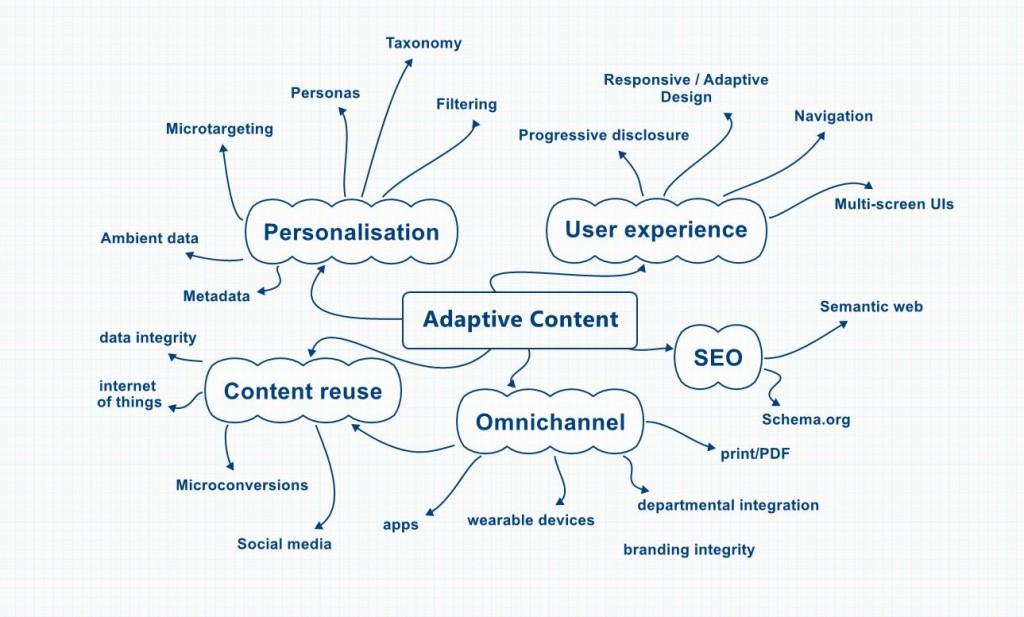
This idea is the new kid on the block. For the purpose of this post, we’ll look at it from a twofold perspective. Adaptive content is a combination of:
These two facets of the term work together to create a complete, well-rounded experience. By implementing it in your content strategy, you’ll turbo-charge your ability to build awareness, trust and engagement with prospects and existing customers.
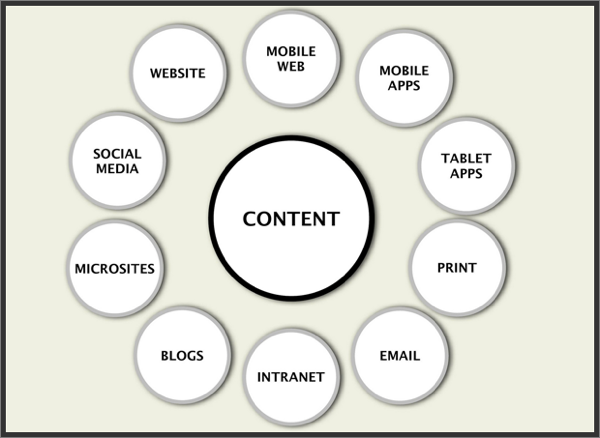
Every channel, device and scenario serve as puzzle pieces that make up the consumer journey. If you look at the hundreds of pieces individually, they don’t make much sense. But if you join them together, you can see the whole image clearly.
In content marketing, it’s time that we start looking at the big picture.
This happens through the development and implementation of a comprehensive content strategy. Your strategy should provide enough insight into the mind of the customer that you’re able to determine a clear direction for personalization.
Before we get any further into the nitty-gritty of adaptive content strategy, I want to talk about the elements you’ll want to look for during the initiative.
Karen McGrane is a superhero on this topic. If you haven’t read her book or heard her speak, you’re missing out on some really great information.
She outlines five elements of adaptive content that are critical to your success. Let’s talk about each of them briefly.
Although I love the elements Karen uses, I think we can simplify it even more. I like to think of it in terms of the common phrase Reduce, Reuse, Recycle.
Once you understand what adaptive content looks like, it’s time to create a stellar strategy…
To begin, we need to first understand the five Ws. You probably remember them from grade school: who, what, when, where and why. By defining the project’s purpose this way, we’ll be better prepared to understand personalization from a strategic perspective.
Who is your audience?
It’s one of the first questions any content developer should ask themselves. Building a strong persona helps you properly cater to them. And that kind of attention can transform the casual visitor into a brand ambassador.
Before you can create effective adaptive content, you must understand your audience.
Step 1: Delve into an analysis of their goals, challenges and pain points. This will help you determine how to best distribute your content. Check out this overview of the 5 Rings of Buying Insight.
Step 2: Create complex, situational overviews of their needs. Get started by answering these questions about each type of audience member.
Step 3: Conduct primary research that brings even deeper insight. You can gather deeper information through things like:
Ultimately, the research you’ll conduct depends on your specific situation. Focus your efforts on creating a unique approach based on your audience, their needs and the type of business you run.
But one thing is the same, regardless: You must understand the who before you take any further steps.
What content best supports the audience?
Too many people have a narrow mindset when it comes to content. They only think of it in terms of written messages or multimedia assets. And while both of those are important components, adaptive content comes from a much higher level of thinking.
To understand what type of content works best, you’ll develop a distinct four-step workflow. These steps take you through research, architecture, development, testing, optimization and a high-powered launch. Once you’ve accomplished it, you’ll know what kind of content works:
Sound complex? Welcome to the future.
When should you actually adapt content?
By its very nature, adaptive content must adapt. That means, it needs to change based on certain characteristics of the individual audience member.
Step 1: Select the characteristics you’ll use to trigger adaptive content. A few options include:
Step 2: Create adaptive rules that trigger adaptive content based on what you’ve defined.
For example, let’s say you run a digital marketing agency. You could create the following piece of personalized, adaptive content:
Here’s an example of what that type of rule might look like in practice:
This kind of execution is intrinsic to adaptive content. Personalization happens through small pieces of content delivered in the appropriate context. When done well, it creates the kind of unique experience that users want.
Where will you display the content?
Determine how you will visually represent your content, and what effect this will have on your content across different devices.
What looks good on a desktop can cause an unfavorable experience in mobile. With the rise of responsive web design, marketers are seeing the harsh reality of poor strategic presentation.
You need to consider the big picture. Truly adaptive content can serve the audience through quality publishing, regardless of the device used. To make this a reality, you’ll need to look at your publishing strategy from a few different angles.
Ultimately, you deliver a great experience to every user. That can’t happen with static content that only serves one device. Using these steps helps you focus on the dynamic possibilities.
Why are you investing in adaptive content.
You need to build a strong business case for adaptive content. It requires a vast investment of time and resources, so it’s important to understand and apply customer research data.
Build a business case for the executives involved in the decision-making process. You have to justify its benefit for your organization’s specific needs and goals, as well as show how adaptive content truly connects all the pieces of the marketing puzzle together.
Take small steps to start implementing personalized adaptive content if you’re not ready to give it a 100% investment. Even small changes can yield long-term rewards. Start with the training wheels on and make small adaptations that will lead to larger ones down the road.
This is the future of content, and you need to jump on board now before it’s too late.
We’ve talked a lot about high-level complexities today. I’d love to hear your thoughts on adaptive content and how it will shape the future of our content marketing efforts. Share your ideas by leaving a comment below.
About the Author: Aaron Agius is an experienced search, content and social marketer. He has worked with some of the world’s largest and most recognized brands to build their online presence. See more from Aaron at Louder Online, their Blog, Facebook, Twitter, Google+ and LinkedIn.